Organic dried pomegranate seeds: technical profile and applications for formulators
Organic dried pomegranate seeds are a functional ingredient with a unique profile, distinct from the peel extracts that dominate the food supplement market. Rich in punicic acid, fibre and polyphenols, they open up original formulation opportunities for brands seeking to make use of the whole fruit within a clean-label, zero-waste approach.
The pomegranate tree and its parts: understanding the raw material
The pomegranate tree (Punica granatum L.) is a fruit tree native to the Middle East and the Mediterranean basin, now cultivated in Spain, Turkey, Iran, Tunisia, Morocco and several countries in sub-Saharan Africa. Its fruit, the pomegranate, is made up of several parts with very different phytochemical profiles, which has a direct bearing on the choice of ingredient for the intended application.
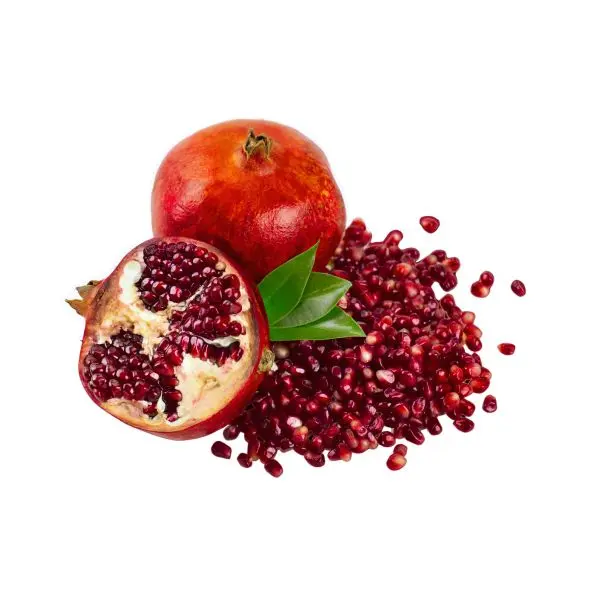
Structure of the fruit: the peel (pericarp) is the part richest in punicalagin and hydrolysable tannins. The arils (small translucent pulpy sacs) are rich in sweet juice, anthocyanins and citric acid. The seeds, located at the heart of each aril, are rich in oil (15 to 20% of the dry seed) with a high punicic acid content, and in insoluble fibre. These seeds are the ingredient covered in this article.
Dried seeds vs peel extract: two ingredients, two formulation approaches
Dried seeds and peel extracts are frequently confused on the market. It is essential to distinguish between them to avoid positioning errors or mismatched expectations on the buyer’s side.
Organic dried seeds
- Raw, unprocessed ingredient
- Profile: punicic acid (omega-5), fibre, moderate polyphenols
- Positioning: clean label, whole food, zero waste
- Applications: snacking, granola blends, bars, enriched flours, seed infusions
- Price: more affordable than standardised extracts
Standardised peel extract
- Ingredient concentrated by aqueous extraction
- Profile: 30–54% punicalagin, >50% total polyphenols
- Positioning: nutraceuticals, high efficacy, capsules
- Applications: food supplements, capsules, stick sachets
- Price: high (very concentrated active/kg ratio)
Point of attention: dried seeds naturally contain little punicalagin — this polyphenol is concentrated in the peel, not in the seeds. If your formulation targets a strong antioxidant claim based on punicalagin, standardised peel extract is the appropriate ingredient. Dried seeds are positioned on a different axis: distinctive fatty acids, fibre and the overall polyphenol richness of the whole fruit.
Nutritional profile of organic dried pomegranate seeds
Conjugated omega-5 fatty acid specific to pomegranate. 60–80% of the seed fat fraction. A lipid profile with no direct plant equivalent.
20–30% of dry matter. Predominantly insoluble fraction. Supports transit, satiety effect, suitable for functional foods.
Present in significant quantities (ellagitannins, ellagic acid, residual anthocyanins). Genuine antioxidant activity, lower than that of the peel.
10–15% of dry matter. An interesting amino acid profile for a fruit ingredient. Contributes to the nutritional density of the finished product.
Present in the fresh fruit, partially degraded during drying. Contribution varies with the process. To be checked on the CoA batch by batch.
Source of potassium, magnesium and phosphorus. A complementary mineral profile in superfood blends.
<8% for good storage stability. To be checked on receipt, particularly after sea freight or in tropical conditions.
15–20% of dry matter (of which >60% punicic acid). Provides caloric richness and a slightly oily texture.
Punicic acid: a unique fatty acid with strong potential
Punicic acid (9Z,11E,13Z-octadecatrienoic acid) is a conjugated omega-5 polyunsaturated fatty acid, present at very high levels in the oil extracted from pomegranate seeds. It belongs to the conjugated linoleic acid (CLA) family and has a stereochemical structure that is unique in the plant kingdom. Its functional interest is the subject of a growing body of scientific research, particularly in the areas of weight management, inflammatory regulation and cell protection. Although health claims directly linked to punicic acid are not yet authorised by EFSA under Regulation (EC) No 1924/2006, it is a strongly differentiating active for formulators working on innovative positioning in nutraceuticals or active cosmetics.
For brands that include dried seeds as a visible ingredient: punicic acid offers a solid scientific communication angle, distinct from the punicalagin carried by peel extracts. The two actives are complementary and make it possible to position “full-spectrum pomegranate” ranges covering both the lipid fraction and the polyphenol fraction of the fruit.
Applications and compatible matrices
| Product format | Technical notes |
|---|---|
| Granola & muesli blends | Dried seeds provide crunch, a natural pink-red colour and a distinctive nutritional profile. Can be added directly without prior treatment. |
| Cereal bars & healthy snacking | Performs well in cold-formed or low-temperature agglomerated matrices. The natural lipid content acts as a partial binder. Combine with dried red fruits (cranberry, goji) for colour and nutritional consistency. |
| Enriched flours & baking mixes | Added as a fine fraction (lightly ground seeds) for nutritional enrichment without major texture change. Recommended dosage: 3–8%. |
| Functional infusions & herbal teas | Dried seeds can be included in herbal blends for hot drinks. Partial release of polyphenols and amino acids on infusion. |
| Powdered superfood blends | Finely ground seeds blend into superfood mixes (with moringa, baobab, hibiscus, açaí). They add nutritional density and matrix diversity. |
| Functional animal feed | An emerging market. Pomegranate seeds are being studied as a functional feed additive for their polyphenol content and antioxidant activity. Demand is developing among premium pet food manufacturers. |
The “whole fruit” approach and CSR positioning
Pomegranate seeds have historically been a by-product of pomegranate juice and peel extract processing. Including them as an ingredient in their own right is part of a whole-fruit valorisation approach, with no waste, consistent with buyers’ and consumers’ growing expectations regarding the circularity and sustainability of food supply chains. For brands building a strong CSR case, organic pomegranate seeds are an ingredient with dual value: nutritional (punicic acid, fibre, polyphenols) and environmental (zero waste, valorisation of a co-product, documented organic supply chain). Proforma Tropical can provide the geographical and social traceability information needed to build this case.
Regulatory compliance and available documentation
On request, Proforma Tropical provides:
- Product technical data sheet with full analytical profile
- Organic certificate (AB / EU Organic) and supplier documentation
- Allergen information in accordance with Regulation (EU) No 1169/2011
- Stability data and storage recommendations
- Geographical traceability information for CSR and responsible sourcing initiatives
Regulatory note: dried pomegranate seeds are a food ingredient within the meaning of Regulation (EU) No 1169/2011. No health claim specific to punicic acid has been authorised by EFSA to date. Claims usable on the finished product must relate to the nutrients present (fibre, potassium, etc.) by meeting the regulatory thresholds in the declared daily portion. We recommend regulatory validation before any commercial communication.
Available packaging
Multi-ply kraft bag with an airtight food-grade liner, protected from moisture and light. Suitable for small and medium production runs. Can be handled manually.
Pallets of 20 kg bags, strapped and stretch-wrapped. For regular production volumes or grouped orders. Tiered pricing on volume commitment.
Recurring supply contracts with secured prices are available for buyers with regular requirements — a lever for controlling raw material costs amid volatile Mediterranean and African fruit prices.
The nutritional and regulatory information in this article is provided for guidance only. Analytical values are representative data and must be verified on the certificate of analysis for each batch. Compliance of claims on the finished product is the responsibility of the manufacturer.